April 29, 2004
Heavy-Handed Raid Backfires, This Time
The 26 April explosions at a chemical warehouse being raided by the U.S. military constitute yet another example of heavy-handed tactics gone awry. US officials say they had reason to believe the facility was being used to manufacture chemical munitions. Rather than use other means to investigate, such as better human intelligence or a more discreet method of entry, the military used its preferred reconnaissance approach: a cadre of soldiers, armored vehicles and a blowtorch. Troops stormed their way into the facility, with horrendous consequences.
The US military reports two soldiers died and fifteen were wounded in two massive explosions that immediately followed troops attempt to access the building.
When I arrived at the scene, a witness told me, People were jumping and dancing on the burning Humvees because of the hatred towards the Americans due to their dealings with Iraqis. People were cheering for Falluja. Images of the aftermath were broadcast and printed throughout the Western media.
In order for Western observers to understand why the deaths of people presented to Western audiences as liberators would be cheered by those supposedly being liberated, the media would need to present the hundreds of raids that result in Iraqi suffereng. Mondays perfume factory calamity was certainly not the first time a military raid in occupied Iraq has backfired on the soldiers carrying it out.
But botched raids typically go unnoticed by the international media because officials are loathe to point them out and reporters rarely follow the numerous leads that circulate around Baghdad and beyond.
Earlier in this month, for instance, the Army conducted an early morning raid searching for weapons in the Abu Hanifa Mosque in a Sunni neighborhood of Baghdad. The fruits for crashing through two gates with tanks, for driving a Humvee over and destroying three tons of food-aid stockpiled for Falluja, for holding 210 people inside the mosque at gunpoint, for smashing through classroom doors and for shooting up walls and ceilings? Not one bullet. The raid wasn't entirely without results for occupation forces, though. The U.S. military gained even more resentment, distrust and rage from the Iraqis in Baghdad.
Troops conduct home raids throughout Iraq on a daily basis. At times these do produce weapons, and sometimes even a person engaged in the increasingly popular resistance to the US-UK occupation. However, a great number of them yield nothing but anguish.
In one case I reported on last winter, a late night raid on a house found soldiers breaking the door to the home of two Baghdad University professors, even though they were offered free access. The home was destroyed, furniture broken and torn apart, bags of rice dumped on the kitchen floor, and the husband and son detained.
The next day soldiers revisited the home, I was told, excusing themselves for having had poor information. The husband and son remain in detention, whereabouts unknown to the family.
The raid on 26 April erupted into more than the two explosions reported by eyewitnesses. The warehouse incident is symbolic of so many raids the occupation forces have conducted. One witness told me he saw the warehouses owner offer a key to the soldiers before they entered, but they refused it, preferring instead to force their way in.
Stories such as this abound on the Iraqi street. More often than not, they end in dead, beaten or detained Iraqis and personal property stolen by soldiers.
This time, because it ended in American deaths, the raid received at least some mention in the Western press.
When human rights organizations estimate that at least half of the 13,000 detainees in the horrid, overflowing Abu Ghraib prison had no affiliation with the armed resistance prior to being arrested by occupation forces, one can imagine how they, their families and friends now view the Anglo-American occupation of their country.
Links, Links, Links
Dahr Jamail has been extremely busy writing lately. If you don't receive Dahr's mailings (see sign-up form in the right column), you may have missed a few things:
TNS Article: "Iraq's Only Disabilities Hospital Desperately Underfunded, Inaccessible"
With more patients than ever as a result of invasion and occupation, Al-Kena rehab is critically low on funds and resources; doctors say patients can't access facilities, hospital can't afford to provide services or make proesthetics.
TNS Article: "Fallujah Residents Report U.S. Forces Engaged in Collective Punishment"
Despite what Marines call a "ceasefire" in Fallujah, refugees trapped outside and Fallujans still under seige continue to face measures of collective punishment in response to persisting defiance of U.S. demands
ZNet Commentary: "
From the , a compelling analysis of US "diplomacy" in Falluja.
at (archived)
Dahr spent two hours fielding very interesting questions online at a very popular Muslim website.
April 27, 2004
Interview with a Mujahedeen, Observations from a Political Scientist
Dr. Womidhe Nidal is a Senior Political Science Professor at Baghdad University. Last night during an interview in his home, he stated, Once you abide by the policy of the U.S.A. you are not a terrorist anymore. In 1991, Syria was not a terrorist because they supported the war against Iraq. Syria opposed the recent invasion, so now they are a terrorist.
When asked what he thought about the Bush Administration referring to the situation in Iraq as the front lines of the War on Terror, he replied, Here, one would have to distinguish between terrorism and resistance. Terror was unseen here before the invasion. In Falluja, it is not terrorism, it is resistance.
In an ominous prelude to a very different meeting I had tonight with a member of the resistance, Dr. Nidal had said, The Americans war against Iraq is over. Now we have the war of Iraq against America. A war of Iraqis fighting for their country, their homes, their money, and their lives.
Tonight, I await a mujahedeen fighter, sipping tea impatiently until the door opens at the pre-set location.
He enters the room, his presence larger than that which his tall height and bulky body projects.
A blue ski mask hides his face, and he chooses to be called Ahmed to protect his identity. With a deep, course voice he introduces himself with the greeting Salam Aleikum (Peace be upon you), and asks my translator and I to join him in sitting.
I am lucky to have been granted an interview with this man. Only by promising anonymity and having this pre-arranged has he allowed it.
I want to tell the truth, but the media does not cooperate with the resistance. The media concentrates on the Americans, and does not care about Iraqis, he says firmly, This is not a rebellion, this is a resistance against the occupation.
When asked what he thought about the Bush Administration referring to the situation in Iraq as the front lines of the War on Terror, Dr. Nidal had stated, Here, one would have to distinguish between terrorism and resistance. Terror was unseen here before the invasion. In Falluja, it is not terrorism, it is resistance.
Tonight Im speaking with a 26 year-old member of the growing resistance who used to work as a portrait photographer and maintained his trade even whilst in the Iraqi Army, when he was a guard at the presidential palace.
Yet he was against Saddam Hussein and rejoiced when the U.S. military managed to topple his brutal regime. In fact, he says he didnt even fight in the resistance against the U.S. during the invasion. But he grew weary of watching his fellow countrymen humiliated, mistreated and killed by the aggression of his occupiers, and like so many others he took up arms to fight against them.
He says, We were under great stress during the time of Saddam. He put me in prison. We were never loyal to Saddam, but now he is representative of us because he is a native of Iraq, he is Muslim, and he is Iraqi.
He says he is a member of a group of 20 who carry out attacks. His group has a narrow relationship with other groups in the resistance. He says, We meet on the day we have a job, then after we complete the job, we dont know each other until it is time for another job.
He says his last job was yesterday.
He says his group has carried out 250 attacks and he, personally, has participated in 70 of them.
How does he know when it is time to meet with his group? He says, When a house or city is attacked by the Americans, we meet and decide what job to do. His group uses Rocket Propelled Grenades (RPGs), Improvised Explosive Devices (IEDs), grenades and Kalashnikovs. We have so many arms, he says gruffly, All that we need to do our jobs.
When asked who comprises the resistance, he hold his hands out and says, Some are Shia, Baathists, Sufis, tribes, and Arab fighters. He adds pointedly, I have been fighting for a year now, and I have not seen one Al-Qaeda fighter, nor have I heard of one fighting in the resistance.
He adds that around half of the Iraqi Police are members of the resistance.
He says the resistance is growing--that even just this week five more men have joined his group. He leans forward and says, As more Iraqis are provoked, more are joining the resistance. Even children who have had their parents killed by the soldiers are joining.
Of a particular 12 year-old boy, he says, He joined because he watched the Americans kill his mother and father. His father was not a fighter, didnt even own a gun. He was looking over a fence and an American sniper shot him. When his mother went to help the father, she too was shot. So he joined us and has killed 22 soldiers. They are now frightened of him, because he carries out attacks on his own.
He says nobody is his group is paid, and many hold regular jobs.
He tells a story of a Sheikh who was not in the resistance, yet US soldiers invaded the Sheikhs home and he was beaten and detained in front of his seven daughters.
Ahmed says he personally knows 120 people, both men and women, who have been detained.
Dr. Nidal had also commented, The crimes against humanity in Palestine are shown daily on the television; this does not indicate that the current U.S. administration is committed to democracy or human rights. Thus, how can a war criminal in Palestine (the U.S.) be accepted as a state builder in Iraq?
Another story Ahmed tells vehemently is that of when he was detained, along with his sister. While in Abu-Ghraib prison he says he watched his sister raped by soldiers, and after three months she was released, pregnant. Why do we not hear about these atrocities in the media? They try to portray us as barbarians when we are defending our homes and our families against U.S. terrorism?
He continues his angry and firm tone, sitting on the edge of his chair while he says, I will stop fighting when the last American soldier leaves Iraq. He takes a deep breath and continues, The Americans are the terrorists. Their military has killed millions of people all around the world. Is killing people like this accepted?
Last night Dr. Nidal stated, Bremers decision to attack Falluja and Sadr simultaneously has brought more unity between the Sunni and Shia than all my work of negotiating to bring them together. The unity is good, because of this I think things are getting better here. National unity is growing. Now people speak of Falluja and Najaf at the same time, although I am sad that it must be under these horrendous conditions.
Tonight when Ahmed is asked how he feels about Muqtada Al-Sadr, he states, They are Muslims and belong to our Prophet Mohammed. Our blood and our ground is the same. They are our brothers.
He is asked what he will do if Falluja is invaded by the military. He again opens his arms and says, We will gather and fight them-the same in Najaf and Kerbala. We are Muslim, because I am a son of Iraq, as they are. We all have the same aim now.
He says he does not know how many soldiers he has killed. He says, So many. During one attack my group killed 35 soldiers. We hit six Humvees with IEDs, then RPGs and grenades, and killed everyone. When we inspected the convoy after we attacked it, nobody was alive, and we took their ammunition.
The statement poignantly reminded me of something Dr. Nidal said just the previous evening, I feel pity for soldiers who are ordered to come here-they are not choosing to come. Then they are killed. And of course this will continue with no policy change.
I then ask Ahmed if there will be increased fighting around the June 30th transfer of sovereignty, even though today the U.S. military admits there are already over 40 attacks on them each day. He says, There is no June 30th for us because the resistance is always growing here. June 30th is irrelevant. Sometimes the resistance lets up and people think it will end. But it will never end. It will never stop.
I thank him for his time and he promptly leaves. As with the agreement, I sit back down and wait 10 more minutes before leaving myself. I take deep breaths and try not to ponder the horrendous days ahead for the Iraqis, the resistance, and the U.S. soldiers here.
As Dr. Nidal had eloquently put it just last night, Violence creates counter-violence, and it always spirals out of control, like we are seeing now.
April 23, 2004
Unexploded Ordinance Update
This past January 3rd a situation which I will include here now, as I followed up on the story yesterday:
January 3rd:
We continue on down the street to find a farmhouse where a bomb from the nightly attacks the US has hit, via Operation Iron Grip.
In this Albu Aitha area of Al-Dora, it is nothing but farmers and wide-open fields, lined with rows of palm trees.
Just beside an old stone house here, an older man points out a large crater, shrapnel scars marking the front of the home and huge chunks ripped out of a nearby palm tree.
The family had been eating dinner two nights ago and the bombing began. They were in a nearby room from area near the strike, or they would have been hit by shattered glass and shrapnel from the explosion.
Hamid Salman Halwan Matar, the owner of the home, said, Two nights ago they bombed here from 6-9 pm, then resumed it again at 4 am. I think it was jets shooting missiles, because I could hear the engines. Last night they bombed some more in this area. I suppose they think resistance fighters are hiding in the fields here.
His wife tells us her children are afraid of any noise now, and have trouble sleeping at night. The family hasnt slept in their home since the bombing 2 nights ago, for fear of another strike on their home.
We dont know why they bomb our house and our fields. We have never resisted the Americans. There are foreign fighters (from another area in Iraq) who have passed through here, and I think this is who they want. But why are they bombing us?
U.S. Army Brig. Gen. Mark Kimmitt told reporters Friday that Operation Iron Grip in this area sends a very clear message to anybody who thinks that they can run around Baghdad without worrying about the consequences of firing RPGs, firing mortars. There is a capability in the air that can quickly respond against anybody who would want to harm Iraqi citizens or coalition forces."
The family took us out into their nearby fields to show us a plethora of unexploded mortar rounds. The white bombs are sticking halfway out of the hardened mud as children play around them, pointing to them with excitement.
I count 9 small tails of the mortar rounds sticking into the air in this small section of the field.
Mr. Shakr, the brother of the man whose home was struck by a bomb, points to a distant hill and says, The Americans shot mortars at us from there. You can see the crater where one exploded, but here are the rest. We had been told the Americans only use sound bombs here, but now we know different.
He goes on to say it was two nights ago when the Americans shot mortars at their fields behind their home, from 6:30-10 pm, then again at 4 am.
We asked if the family had requested that the Americans come remove the unexploded ordnance.
Mr. Shakr, with a very troubled look, said, We asked them the first time and they said OK, well come take care of it. But they never came. We asked them the second time and they told us they would not remove them until we gave them a resistance fighter. They told us, If you wont give us a resistance fighter, we are not coming to remove the bombs.
He holds his hands in the air and says, But we dont know any resistance fighters!
He grows somber, and quietly says, We will have to leave this land because we cannot farm our fields with bombs in them.
Yesterday, April 22 -- I revisit the family. The mother of the family tells me that the bombs ended up being removed by local Iraqis who tied ropes on them and pulled them out themselves, several of them exploding as they did so.
Prior to this, soldiers had searched the area and instructed the family that they would not be removing the bombs, as they had been fired by the mujahedeen. This, of course, directly contradicted what the soldier at the nearby U.S. base had previously told the family.
They have been able to resume farming now. As with Arab custom, we are offered something -- some fresh goat milk, which my interpreter and I drink from a metal bowl. Little children stare at us, then one of the little girls walks towards the field with a sack over her back.
Her mother turns to us and says, We hope the Americans dont come back here. We just want to be left alone.
Endless Suffering, U.S. Military Terrorism
I noticed myself last night during a radio interview reporting that things in Baghdad lately have been relatively calm. Relatively. Its funny what we get used to, what we adapt to and normalize.
Here is what relatively calm looks like in Baghdad on a daily basis-using the last 24 hours as an example. Early this morning I was awakened by a huge explosion quite a distance off. Far away, yet large enough to wake me and shake my bed, followed by a couple of smaller explosions. Nearly every time a bomb goes off, people are killed.
There is sporadic gunfire every night--this in one of the better areas of central Baghdad. Several friends of mine who live in Adhamiyah district report that on a nightly basis the U.S. base there in the Adhamiyah Palace is bombed by mortars. This is the same area where a South African mercenary was shot dead yesterday.
Aside from the mercenary being killed (reported by the corporate media as a South African civilian), I havent seen any of the bombs nor gunfire reported.
Then there is always the less obvious toll of the occupation upon the Iraqi people, as far as the news is concerned. The suffering is everywhere. Anyone traveling outside the Green Zone cannot help but have it thrust in their face. Begging women and children on the streets, people with disabilities sitting legless near buildings holding out their hands for a few dinars.
Nearly every car on the street looks as though it has been pulled from a scrap yard. The electricity blinks on and off, and if you are lucky, you have heated running water for a shower.
Stay here long enough and it inevitably hits closer to home. Emad is a middle-aged man with a kind heart who works at our apartment. He is always cleaning, treating us as though we were in a five star hotel-even though the accommodations couldnt be any further from this. He never lets one of us walk up the stairs carrying anything--sweating and breathing heavily he insists on carrying whatever groceries or bags we might be holding.
A few days ago he told me his wife needed an operation, but he didnt have enough money for it. He explained that it was $15, and I gave it to him.
This morning Emad is collecting the garbage from the apartments. He is crying. When we ask what is wrong, he tells us that his wife has died of cancer. I hug him, while he is apologizing. He is apologizing! For showing me his grief? For burdening me with his loss?
We take up a collection and give it to him, as he will be off work the next few days for his mourning period.
Another man who is a front desk clerk at a hotel I used to stay at told me his wife has breast cancer. He thinks it is from eating radioactive tomatoes from southern Iraq. Depleted Uranium.
Literally every Iraqi Ive gotten to know has either a family member or friend who has been killed by U.S. soldiers or the effects of war/occupation, such as Depleted Uranium, not enough money for proper medical care due to 70% unemployment, or another of the myriad of effects caused by the aforementioned.
Meanwhile, the heavy-handed tactics of the U.S. military continue to effect people here in other ways, one of which I will discuss in my next blog.
April 22, 2004
TNS Articles Posted: Falluja Detainments and Abu Hanina Mosque Raid
We've posted two more hard news articles by Dahr Jamail on The NewStandard website. (We're also very close to re-launching TNS with a whole new format, including lots more Iraq coverage.)
The first new article is "Insurgents Detain and Release Humanitarian Activists Near Fallujah". The other new piece is a hard news version of last Wednesday's weblog entry with a brief update, now entitled: "U.S. Troops Raid Abu Hanifa Mosque, Destroy Fallujah Relief Goods"
April 19, 2004
Baghdad Doctors Reporting Cluster Bombs in Falluja, Harrassment of Patients by Troops
The word on the street in Baghdad is that the the cessation of suicide car bombings is proof that the CIA was behind them. Why? Because as one man states, "[CIA agents are] too busy fighting now, and the unrest they wanted to cause by the bombings is now upon them." True or not, it certainly doesn't bode well for the occupiers' image in Iraq.
The night before last I was awakened by a very large explosion in central Baghdad, followed promptly by three other smaller explosions. This morning, I awoke to another large explosion, again followed by several smaller ones.
With so many journalists leaving Iraq, and the majority of those that remain staying close to their hotels, it's becoming harder to come by accurate information aboutevents occurring on the ground.
For those of us here, it has, needless to say, travel has become increasing difficult because of the deteriorating security situation.
Aside from the usual bombs and sporadic gunfire that typifies daily (and nightly) life in the capital of Iraq today, it continues to be relatively quiet here, at least compared to other parts of Iraq. The feeling I get is that most Iraqis here (aside from those directly fighting the military) are in wait-and-see mode, their eyes on Najaf and Falluja.
But this belies the true story, that despite the lack of overt fighting in central Baghdad, violence and tension are boiling beneath the surface. On a recent visit to the Arabic Children's Hospital, Dr. Waad Edan Louis, the Chief Visiting Doctor at the hospital, stated, "Before the invasion, we had 300 patients per night. Now, we have 100 because the security is so bad."
Meanwhile, at the Noman Hospital in Al-Adhamiya, a doctor I spoke with there (who asked to remain nameless) stated, "We are treating an average of one gunshot wound per day, which is something we never saw before the occupation. This is due to the absence of law in Baghdad. The Iraqi Police have weak weapons and nobody respects their authority."
He also stated that U.S. soldiers have come to the hospital asking for information about resistance fighters. He said, "My policy is not to give my patients to the Americans, or to provide them any information. I deny information to the Americans for the sake of the patient. I don't care what my patients have done outside the walls of the hospital. I do my job, then let the patient go."
"Ten days ago this happened -- this occurred after people began to come in from Falluja, even though most of them were children, women and elderly."
When asked if the U.S. military were bombing civilians in Falluja, he stated, "Of course the Americans are bombing civilians, along with the revolutionaries. One year ago there was no revolution in Falluja. But they began searching homes and humiliating people, and this annoyed the people. The people became angry and demonstrated, then the Americans shot the demonstrators, and this started the revolution in Falluja. It is the same in Sadr City."
He continued angrily, "Aggression against civilians has caused all of this. Nothing happened for the first two months of the occupation. People were happy to have Saddam gone. And now, we hope for the mercy of God if the Americans invade Najaf."
Cluster bombs arereported to have been used commonly in Iraq both during the invasion and the occupation.
Another doctor at Noman Hospital, who asked to remain anonymous, stated that he saw the U.S. military dropping cluster bombs on the Al-Dora area last December, "I've seen it all with my own eyes. The U.S. later removed the unexploded bombs by soldiers picking up the bomblets and putting them in their helmets."
He also believes that cluster bombs are currently being used in Falluja, based on reports from field doctors presently working there, as well as statements taken from wounded civilians of Falluja.
He also claimed that many of the Falluja victims he had treated had been shot with dum-dum bullets', which are hollow point bullets that are designed to inflict maximum internal damage. These are also referred to as expanding bullets.'
Nearing the end of the discussion, the first doctor stated, "The U.S. induces aggression. If you don't attack me, I will never attack you. The U.S. is stimulating the aggression of the Iraqi people!"
A doctor who asked to remain anonymous at Al-Karam Hospital in Baghdad reported that another doctor from his hospital had just returned from Najaf. She was unable to work there, she told Al-Karam, because Spanish military forces had occupied its hospital. The roof of the Al-Sadr Teaching hospital in Najaf overlooks their base, so soldiers have taken it over for strategic purposes.
The doctor at Al-Karam Hospital stated, "The Americans don't care what happens to Iraqis."
At Al-Kerh Hospital in Baghdad there is a similar story. One of the managers at the hospital, speaking on condition of anonymity, stated, "U.S. soldiers are always coming here asking us for information about our wounded, but we don't give them any information."
Hussein Kareem, the Assistant Administrator at the Mohammed Baker Hakim Hospital in Sadr City, said that while no soldiers had occupied or visited the hospital, U.S. soldiers shot one ambulance from his hospital, injuring the driver. He also stated that during the first day of fighting in Sadr City two weeks ago, he received 32 dead bodies, mostly of women and children, and 90 wounded.
At Yarmouk Hospital, a lead doctor discussed the situation in Falluja.
He said that during the first days of the U.S. siege of Falluja, many of the wounded were brought to his hospital. He continues, "The Americans came here to question my patients, even though we tried to refer the soldiers to a different hospital."
He is outraged by the situation in Falluja, which he calls a massacre, "The Americans shot at some of our doctors who were traveling to Falluja to provide aid. One of our doctors was injured when a missile struck his vehicle. I have also been told by my doctors in Falluja that the Americans are shooting ambulances there, as well as at the main hospital there."
He continued, "My doctors in Falluja have reported to me that the Americans are using cluster bombs. Patients we've treated from there are reporting the same."
It is argued that the use of cluster bombs is a war crime, at least in spirit, if not technically. Cluster bombs contravene the international treaty against land mines -- which the U.S. has refused to sign anyway -- because they leave unexploded ordnance where they are dropped, which then has the same effect as land mines.
He continued, "One of my doctors in Falluja asked the Americans there if he could remove a wounded patient from the city. The soldier wouldn't let him move the victim, and said, We have dead soldiers here too. This is a war zone.' The doctor wasn't allowed to remove the wounded man, and he died. So many doctors and ambulances have been turned back from checkpoints there."
This same doctor reported that he saw American soldiers killing women and children, as well as shooting ambulances in Falluja.
The doctor I spoke with expressed his outrage, "What freedom did America bring us? Freedom of the machine gun? So I am free to take my gun and shoot you?"
April 18, 2004
Iraqi Health Minister Presses Authorities to explain U.S. Targeting of Falluja Ambulances
Baghdad, April 17 -- A thundering explosion rocked my bed at just before 8am this morning ... followed by the cracking of light weapons fire. I met a few of my friends shortly thereafter atop our apartment building, looking for the smoke that often follows roadside bombs, but we were unable to spot the location of the attack.
Life in Baghdad today continues to be lived on edge -- pins and needles really -- awaiting the outcome of the Najaf standoff between U.S. troops and Muqtada Al-Sadr. Everyone shudders to think what will occur if the U.S. decides to invade the holy city where the radical Shia cleric is holed up.
Yet the U.S. policy of threatening him, then announcing the goal of detaining or killing him has drawn more followers towards his radical and violent ways. While Al-Sistani continues to attempt to keep his followers in line, more are drawn to Al-Sadr for his open vehement thrashing of the U.S.-led occupation. He refuses to acknowledge any legitimacy of the U.S. in his country, and more and more Iraqis are nodding in agreement with his speeches.
The danger, of course, lies in having Sistani and his followers drawn into this conflict between Sadr and the U.S. military here.
I attended a press conference today at the Ministry of Health, led by the Iraqi Minister of Health himself. In short, he held the press conference to stave off criticism of not doing enough to assist (medically) the besieged and suffering residents of Falluja, as well as some of the areas down south where fighting has occurred.
Al-Iraqia television, the Coalition Provisional Authority-run propaganda station that most of my Iraqi friends call the "CIA Station", was at the press conference. They packed up and left promptly after the minister and his two doctors finished their discussion, entirely missing the pointed questions that were to follow.
A stunning surprise, however, was that the minister acknowledged the U.S. military had been intentionally targeting ambulances in Falluja. He expressed his outrage over the matter, and stated that he had personally pressed the Iraqi Governing Council (IGC) and Bremer for explanations about why these human rights violations, as well as violations of the Geneva Conventions, are occurring.
He said that the U.S. military had accused mujahedeen in Falluja of using ambulances for fighting, and that is why Marines were firing on them. Perhaps there is some truth in this, but at the same time, ambulances that were being used legitimately are being targeted as well, and innocents are dying. My personal friends Jo Wilding and David Martinez were riding in one of these that received 5 sniper rounds through it. I can vouch that they are not mujahedeen.
The minister said that he tried to negotiate with the military, promising to try to insure that ambulances were cleared, and not being used by the mujahedeen.
I asked the minister if he would comment on the U.S. military using cluster bombs in Falluja. When I was in Falluja last weekend I took several statements from citizens there that said cluster bombs were being used on civilians (that they are being used at all in Falluja is a war crime), and when my friends Jo and David returned there several days ago, they reported hearing the distinctive sound cluster bombs make often through the night in Falluja.
I too have heard the horrendous sound, for during my last trip in Iraq when Al-Dora was being bombed on a nightly basis for a few nights, I heard the other worldly sound--a long buzz which sounds almost like a roar, then an explosion, another buzz, followed by several random explosions going off (these would be the "bomblets"). It's really difficult to describe with words, as I've never heard anything quite like it. A gruesome sound, knowing that on the other end of it is found shredded and burning bodies.
A doctor sitting next to the minister took the microphone and said that as a surgeon himself, there was no way to differentiate between bombs by the wounds they make on bodies.
So my question was effectively dodged.
The Ministry of Health is near the Medical City, and on our way out I sadly watched a man with one leg and one of his hands heavily bandaged riding out from the hospital on a donkey. My face is slammed up against the level of poverty and struggle here in Baghdad on a daily basis.
Nearly every traffic jam finds me looking sadly out the window at women and children begging; sometimes I give some dinars, sometimes I stare at my feet and just stomach the sadness. My God the people of Iraq have suffered so much, for so long. And now the liberators have brought one of the bloodiest, most chaotic situations to them that they have known in a long time.
More and more Iraqis I meet say, "This is worse than Saddam." So many of them are Shi'ite. I have not heard one Iraqi ever refer to the resistance fighters as "terrorists." The only time I hear that term used is when Iraqis refer to the U.S. military, George Bush, or the suicide car bombers.
My interpreter Yousef doesn't want to be working with foreigners anymore, but he desperately needs the money. Last time I was here (in December/January) I visited his home; this time, he can't take me because he can't risk having his neighbors see that he is working with me. This is the climate in Baghdad for anyone working with foreigners in any capacity.
The flights leaving Baghdad airport continue to leave full on a daily basis...those of us here continue to watch Najaf and Falluja closely...
April 15, 2004
A Threatening Leaflet, a Threatening Mr. Bush
Save us from the horrendous rumor mill of Baghdad. Yesterday we heard a good one: that the Mehdi militia is spreading leaflets around sections of Baghdad instructing people to inform them of any westerners residing in their area.
Almost everyone I know, including most of the NGOs, is leaving now the first chance they get. I've still been able to work yesterday and today, but when that becomes impossible, there is no use in my staying here any longer. The biggest threat is, of course, being kidnapped.
One can work around the fighting -- just stay away from it. But the randomness of the kidnapping is another story. We are all completely powerless over that situation.
Fortunately I was able to work some today. Over in Adhamiya we had an interview with Professor Adnan Mohammed Salman al-Dulainy at the Diwan Wakfa-Sunni. He is the director of the board in charge of all of the Sunnis in Iraq, with over 10,000 Imams under his control, who also serve as the Friday prayer speakers in the mosques.
He has been a teacher for 51 years. His first words to us were, "Our situation is bad. We are struggling now." He went on to tell us that in the past few days, three mosques in Baghdad have been attacked by the Americans: Abu Hanifa, which I reported on yesterday, and two others on Palestine Street.
He discussed the obviousness of the problems: high unemployment and the dissolving of the Iraqi Army by Bremer as being two huge problems caused by the American occupation that need to be resolved promptly if there is to be any stability here.
He went on to say, "Mr. Bush declared Iraq will be the example of democracy for the Middle East. What has happened here does not give that impression."
His deep frustration with the fact that so many Sunni Imams have been killed, as well as many detained by the Americans, is obvious.
Afterwards I was at an internet cafe run by the son of a good friend. Ali speaks English well, and walked up to me with a leaflet he said had just been passed to him by a car that was distributing them throughout Baghdad. It read:
To our people of Baghdad. Please do not leave your houses. Do not go to schools, colleges, offices or markets. Close all commercial shops. This is in effect from April 15-April 23.
Because your brothers of the mujahedeen from Ramadi, Khaldia and Falluja will bring the resistance to the capital of Baghdad, to help their brothers the mujahedeen from the Mehdi Army to liberate you from the occupation.We told you.
Signed, Mujahedeen Troops
Threatening leaflets similar to these were distributed around Baghdad last fall, causing a three-day rest in the city when the majority of people followed its instructions. While there were some attacks, it ended up being not too big of a departure from the usual resistance to the occupation.
While this leaflet is quite disturbing, it does seem a bit hard to believe that any of the mujahedeen from Falluja would decide to leave there to come fight in Baghdad as they more than have there hands full at home for the time being.
Nevertheless, in Baghdad today chaos, uncertainty, fear and anxiety reign. Everyone is on pins and needles awaiting the outcome in Falluja and Najaf. Everyone I've spoken with here feels that if the U.S. launches an attack on either city, this already horrendous situation will explode in a way most don't want to even think about.
Yet Mr. Bush has discussed that America cannot fail here, and that he will use any means necessary to bring "democracy" to Iraq.
Does anyone else feel like the Bush Administration is pushing us as fast it can towards the abyss of unbridled violence and chaos in Iraq and beyond?
As the purported "ceasefire" in Falluja continues, U.S. war planes are bombing homes, and the bodies of women, children and other unarmed civilians are reported by hospitals there to be piling up.
I recently wrote of my Falluja story for The Nation's website. The piece has since been attacked by a couple of right-wingers, one questioning my credibility and even insinuating that I may have not have even gone to Falluja. Amazing that someone sitting behind a desk in America would have the gall to even suggest this of anyone who is willing to work in this mayhem of Iraq.
It feels like the calm before the storm today. Aside from the Sheriton Hotel being hit by another rocket not long ago, it's been strangely quiet in Baghdad today.
April 14, 2004
Winning Hearts and Minds
Last night an older Iraqi man in his shop on Karrada Street told me, "The situation here is worse than I can ever remember. How the Americans handle things in Falluja and down South over the next few days will determine everything. I still can't understand their policy here. Where is the freedom they promised?"
Adhamiya, Iraq -- This morning while I was on the roof of the apartment talking with a radio station in Connecticut, a huge explosion went off in the Coalition Provisional Authority (CPA) area just across the Tigris from me. Not long after that, another went off at the Sheraton Hotel, then another in the other direction caused by a rocket flying just overhead. All of this was followed by sporadic gunfire to the north. Life in liberated Baghdad today.
It feels quite surreal to hear the news this morning that General Sanchez has announced the military is preparing to kill or arrest Muqtada Al-Sadr in the holy city of Najaf, as troops are amassing around the city.
Shortly after receiving this news my good friend Abu Talat called me and said that on Sunday at 7am he went to look outside his home in Adhamiya, a Sunni neighborhood in Baghdad. He opened the gate to find an American soldier kneeling with a gun aimed down the road. There was also another soldier laying down in his yard aiming his gun in the same direction, and several tanks were coming up from behind them. The fighting was raging between US troops and the resistance.
This cannot be verified, but he claims the Americans lost 5 tanks, 7 Humvees and 30 soldiers in the fighting. He states that 4 Iraqis were killed, and 7 wounded. Resistance fighters battled the Americans in street fighting with RPGs and Kalashnikovs.
What caused this?
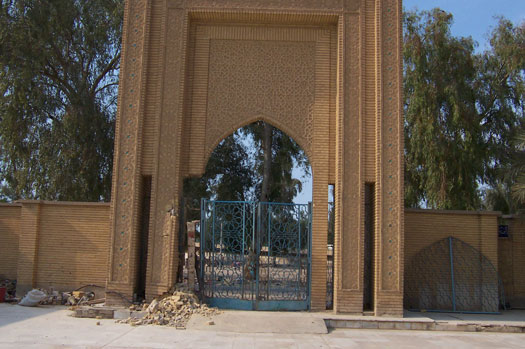
Mr. Alber, a spokesman at the Abu Hanifa mosque in Adhamiya, explained the situation to me this afternoon in a room at a Sunni mosque in the area. Prefacing his discussion about what occurred here, he pointed out that the Abu Hanifa mosque is not only the most important Sunni mosque in Iraq, but also one of the most important in all of the Middle East.
Mr. Alber took a deep breath, and began the story. "On April 11th at 3:30am, Americans raided the mosque by using tanks to crash through the gate to the area where food was being stored for the besieged people of Falluja. The other gate a tank smashed through was over near the student dormitory and the martyr's cemetery."
He went on to say that a Humvee was then driven through the gate and onto the food supply for Falluja, destroying three tons of food. I had previously seen the decaying bags of foodstuffs that were ripped open by the Humvee's huge wheels. 40 soldiers entered the mosque while about 60 more guarded the outside. Those inside went first into the main area of the mosque where people had been praying. Many Red Crescent Society (Iraqi Red Cross) volunteers from Kirkuk were resting prior to delivering more aid to Falluja. The soldiers entered with their boots on, made everyone stay on their knees with their faces down on the ground, and held guns to them.
Mr. Alber angrily raised his voice and told me, "I speak good English. I pleaded with the Americans to let us open all the doors for them so they wouldn't further damage our mosque. I was afraid of what this would cause in the people if they found out. But the Iraqi translator they had yelled at me, 'Silence! Shut your mouth!'"
Mr. Alber had on a previous occasion talked with General Rabin, who is in charge of the American base in the area. He asked the general if he could explain the delicate situation of the mosques to him, so they would cease inflaming the people of the area by their blatant disregard for the traditions of their religion. The general told him to keep his mouth shut. Mr. Alber held up his hands and said, "I feel the general is a good man, but has bad information. We never keep weapons in our mosque -- only three Kalashnikovs to guard it as people guard hospitals."
While holding all the people in the mosque at gunpoint for 2 hours, the soldiers broke in nearly every door in the mosque that was closed, even many that were unlocked. I had walked around in the school (Imam Adham Islamic College is within the mosque compound, just as many private schools are attached to churches in the U.S.) and seen door after door smashed in, with random bullet holes in the walls and ceilings. Students' papers lay strewn about an instructor's desk, a mess caused by US troops rifling through them -- looking for what?
Mr. Alber stated, "After two hours of being held with our faces on the ground and Americans putting their feet on people (a huge insult here), the soldiers did not find one bullet. Then they simply left. A year ago they would apologize for these things. Now they have cancelled their apologies. Now they apologize by stomping on our necks!"
This is the third time Abu Hanifa has been raided by the Americans. The first time was exactly one year ago to the day of this most recent raid. It was also raided in December. I had covered that when I was here last, and took photos of shots fired into the outer walls and clock tower of the mosque. Mr. Adel said of this, "This is our one year anniversary present for the first raid."
There are over 200 tons of food collected at this mosque to be delivered to Falluja. Bags of food and supplies lay in a courtyard awaiting delivery, brought in from all over Iraq. I found tears in my eyes while looking at this outpouring of aid for the besieged Iraqis of Falluja.
While we were walking to the other side of the mosque, a woman from Falluja had just arrived, weeping, with her son. She explained to the men at the mosque that she had no ID card as the Americans had taken it, and was here begging for aid. Residents of Adhamiya have begun housing the refugees of Falluja by the hundreds, if not thousands. One family is said to have taken in 8 entire families from Falluja, and would not allow anyone to remove any of them. They insisted upon caring for as many as they possibly could. This is Adhamiya.
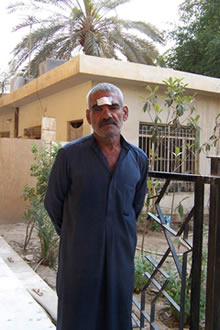
Around the other side of the mosque I am introduced to Kassem, a 54 year-old grandfather who is blind in one eye and has a disability in one of his legs. He works as a guard at the mosque, and lives within the compound with his family and grandchildren. He stands talking with us and I notice the obvious bloody bandage on his forehead.
When the Americans crashed in the door to his humble home where he was with his family, he stood up and a soldier smashed his head with the butt of his M-16, knocking him to the ground. He points to his leg and says, "When I fell to the ground they kicked me! They came to humiliate the people of Islam. Why else? We have no guns here, no mujahedeen. They want to destroy the Islamic religion."
After talking with Kassem we visit the Shahid (martyr) cemetery within the compound. Over 60 bodies are buried there, yet it is reserved for those deemed martyrs, mostly from the area. The majority of graves are of locals who died defending Adhamiya during the invasion on April 19, 2003, but there are others. Four fresh graves are from fighters who died battling the Americans the day after the mosque was raided. Two young boys sit near the grave on one of them, a 19 year-old man, a good friend of theirs. They visit it every day, and plan to continue to do so indefinitely.
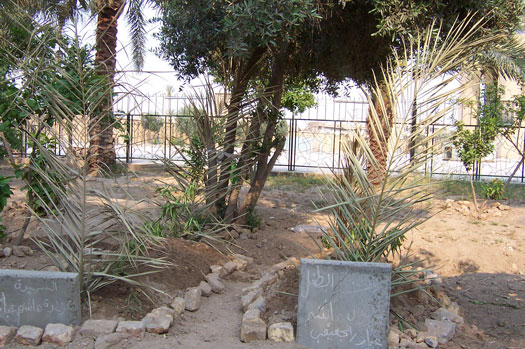
Another grave is from a demonstrator shot by the Americans, and another is a man who was shot by an Apache helicopter at a checkpoint in Mosul.
There are two other fresh graves. One is a 9 year-old boy, the other his 16 year-old sister. Both were from Falluja.
Earlier Mr. Alber had told us, "I was against Saddam. I was jailed by his regime in 1996 for making pastries because sugar was being rationed due to the sanctions. But the U.S. policy now in Iraq will fail 100%! No people here support them now."
He took a deep breath after this and calmly, yet firmly stated, "The managers of the U.S. policy here are not clever people. When you come by terrorism, you create terrorism."
A little later while getting into the car we hear gunfire very nearby. After driving a short distance Abu Talat asks me to please cover my head. I pull my kefir up around my bearded face.
Driving home we pass several large plumes of billowing black smoke, which I have been here long enough to identify as more U.S. military vehicles ablaze.
The flame billowing from the distant wreckage in Al-Dora was raging higher in the darkening sky than I've ever seen it reach before.
April 13, 2004
Listen to Dahr
Dori Smith of the show "Regime Change Radio" on in Connecticuit has posted several interviews conducted with Dahr Jamail from Baghdad. Here are the latest clips...
Regime Change Radio, heard Thursdays at 5PM in Storrs, CT, is a one half hour program on the importance of voting to bring about regime change in America. Producer Dori Smith of WHUS Storrs hosts independent and mainstream reporters, peace activists, and scholars.
NewStandard Article Posted: No End in Sight for Fallujah
Hot off the presses, the "hard news" version of Dahr's findings in Fallujah, as well as a general overview of the situation there.
"No End in Sight as Fallujah Death Toll Approaches 700" by Dahr Jamail, The NewStandard
April 12, 2004
Staying Put
I have just decided that I will be holed up in my apartment for the next two days, so don't expect to hear from me. I will phone in short blogs to the NewStandard staff to post for me.
No respite from the Violence
Baghdad--When we returned from Falluja yesterday I felt like I could let my guard down somewhat. For in Baghdad, at least compared to Falluja, there have always been pockets of relative calm. The apartment where Im staying is supposedly one of those.
We got news from (CPT) that most of the NGOs left in Iraq are either pulling out completely, or leaving a skeleton crew. There is also talk of supposed organizing of a UN airlift in the works to fly folks out. But at the same time, there is also talk of the airport closing due to security problems.
In addition, the road to the airport is extremely dangerous because there are many attacks there daily. The other side of the equation is even more horrendous--the main road to Amman is closed at Falluja--still passable by taking side roads around the closed highway. But weve heard reports that foreigners are being pulled from cars, shot, and left there by various militia.
Im currently strongly considering leaving but it is so volatile that what the safest option may be is changing on an hourly basis. For right now, I just bought some groceries and am holing up in my apartment with my friends.
A few days ago Firdos Square--where the infamous pulling down of Saddams statue occurred after the invasion--was closed and blockaded by the American military. I stood atop my apartment listening to a speaker on a Humvee blaring instructions that anyone who approached the area would be shot on sight. This is freedom.
Apparently the U.S. is prepared to take these measures to prevent another demonstration from occurring there.
Were using dark humor to lighten the extremely tense mood here--joking about what we can do if one of us is kidnapped. Jo promises to let any kidnappers know how that I just completed a humanitarian mission to Falluja. I will most certainly tell them she founded an NGO that entertains Iraqi children with a traveling circus, as well as works to aid them.
An Iraqi policeman who knows some nearby flat-mates has given a few of the folks here a ride to the internet café before. He just stopped in to ask if we would like a ride today. He also used the opportunity to tell us Sadrs Medhi militia is planning on targeting this area tomorrow and the next day for kidnappings. Guess what my plans are for the next couple of days? Good thing I just bought groceries. We are joking (morbidly) about hiding in the water tanks on the roof. Well move soon most likely, were just trying to find the best option.
But it is odd here--this area has consistently felt like the hole in the donut--the bustling street nearby is full of lights, traffic and shoppers each night, children playing in the street in the evenings.
However, even now many of the stores are closed, and traffic is notably lighter. Even many of the Iraqis themselves are afraid, for nobody really has any idea what might happen next. For this is worse than a war, due to its randomness. There are so many groups battling against the US occupation and targeting foreigners it seems like a closer comparison than Vietnam would be Beirut.
Solutions? One thing that remains glaringly apparent today is that Falluja has become another rallying point for the resistance. While most media in the U.S. (and many other Western countries) are failing to report the Iraqi side of the story there, everyone here knows its turned into a full-on massacre, and people are extremely angry. This and the entire debacle of how the Americans have handled the situation with Muqtada Sadr, have together brought rivers of volunteers into the already growing resistance to the occupation.
Thus, if the U.S. doesnt pull out of Falluja, the situation is only sure to worsen. God help us if/when they launch a full on incursion into the city, including increased air strikes. When will whoever is making these unbelievably stupid strategic decisions for the military here wake up?
I would also like to comment on the insane disparity I see in the reporting from CNN and some of the other mainstream media. Ive watched several of them on the television, and last night CNN had the gall to say that the ceasefire was holding in Falluja, aside from some Iraqi snipers firing at the Americans there. NPR, NY Times, and several others have reporters embedded with the military there as well.
This is difficult for me to see, particularly after being there yesterday and seeing an ambulance with 3 bullet holes in the drivers side of the windshield. Seeing slain women and children, elderly, unarmed people. All killed and/or wounded by the American snipers. How can the media report this when they dont even have a correspondent in Falluja? Why are they failing so completely to report the Iraqi side of the story? How much more obvious can it be that they are only parroting the U.S. military lies concerning the situation?
So Americans are killing unarmed Iraqis in Falluja (and elsewhere) because they have the wrong colored skin. And now many Iraqi resistance fighters are responding in kind--killing or kidnapping any foreigner they find.
Several of our Iraqi friends and interpreters now have told us they have received death threats for working with us. Everyone is afraid, and more and more people are simply staying at home. Fighting rages rampantly throughout the country, aside from Kurdistan. What hope for the future do Iraqis have? All of my Iraqi friends are simply holding on day to day.
Yesterday George Bush said he knew what we were doing in Iraq was right. Mr. Bush, does this include massacring unarmed women, children and elderly in Falluja right now? When you say you believe the soldiers in Iraq are acting brilliantly, does this include the snipers shooting ambulances with blaring sirens and flashing lights? Does this include dragging the entire country into a bloody chaos that is worsening by the hour?
In the last week there have been over 600 Iraqis slain in Falluja alone, with thousands more wounded. In this same week over 62 U.S. troops killed, and most certainly hundreds more wounded.
April 11, 2004
Americans Slaughtering Civilians in Falluja
I knew there was very little media coverage in Falluja, and the entire city had been sealed and was suffering from collective punishment in the form of no water or electricity for several days now. With only two journalists there that I'd read and heard reports from, I felt pulled to go and witness the atrocities that were surely being committed.
With the help of some friends, we joined a small group of internationals to ride a large bus there carrying a load of humanitarian supplies, and with the hopes of bringing some of the wounded out prior to the next American onslaught, which was due to kick off at any time now.
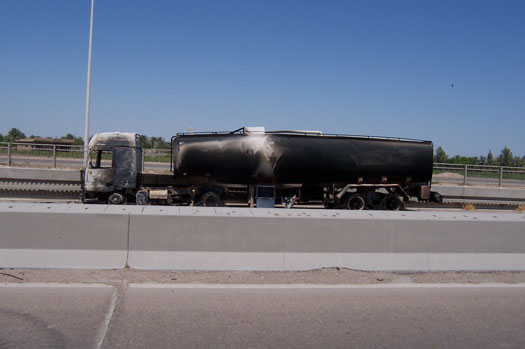
Even leaving Baghdad now is dangerous. The military has shut down the main highway between here and Jordan. The highway, even while just outside Baghdad, is desolate and littered with destroyed fuel tanker trucks -- their smoldering shells littered the highway. We rolled past a large M-1 Tank that was still burning under an overpass which had just been hit by the resistance.
At the first U.S. checkpoint the soldiers said they'd been there for 30 hours straight. After being searched, we continued along bumpy dirt roads, winding our way through parts of Abu Ghraib, steadily but slowly making our way towards besieged Falluja. While we were passing one of the small homes in Abu Ghraib, a small child yelled at the bus, "We will be mujahedeen until we die!"
We slowly worked our way back onto the highway. It was strewn with smoking fuel tankers, destroyed military tanks and armored personnel carriers, and a lorry that had been hit that was currently being looted by a nearby village, people running to and from the highway carrying away boxes. It was a scene of pure devastation, with barely any other cars on the road.
Once we turned off the highway, which the U.S. was perilously holding onto, there was no U.S. military presence visible at all as we were in mujahedeen-controlled territory. Our bus wound its way through farm roads, and each time we passed someone they would yell, "God bless you for going to Falluja!" Everyone we passed was flashing us the victory sign, waving, and giving the thumbs-up.
As we neared Falluja, there were groups of children on the sides of the road handing out water and bread to people coming into Falluja. They began literally throwing stacks of flat bread into the bus. The fellowship and community spirit was unbelievable. Everyone was yelling for us, cheering us on, groups speckled along the road.
As we neared Falluja a huge mushroom caused by a large U.S. bomb rose from the city. So much for the cease fire.
The closer we got to the city, the more mujahedeen checkpoints we passed -- at one, men with kefir around their faces holding Kalashnikovs began shooting their guns in the air, showing their eagerness to fight.
The city itself was virtually empty, aside from groups of mujahedeen standing on every other street corner. It was a city at war. We rolled towards the one small clinic where we were to deliver our medical supplies from INTERSOS, an Italian NGO. The small clinic is managed by Mr. Maki Al-Nazzal, who was hired just 4 days ago to do so. He is not a doctor.
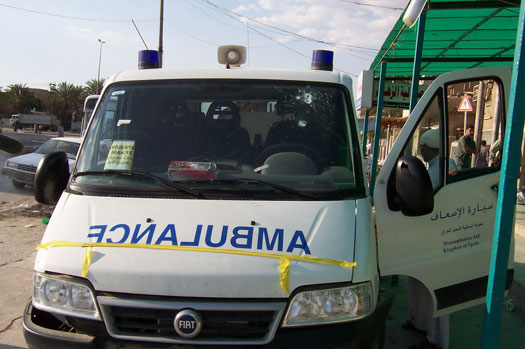
He hadn't slept much, along with all of the doctors at the small clinic. It started with just three doctors, but since the Americans bombed one of the hospitals, and were currently sniping people as they attempted to enter/exit the main hospital, effectively there were only 2 small clinics treating all of Falluja. The other has been set up in a car garage.
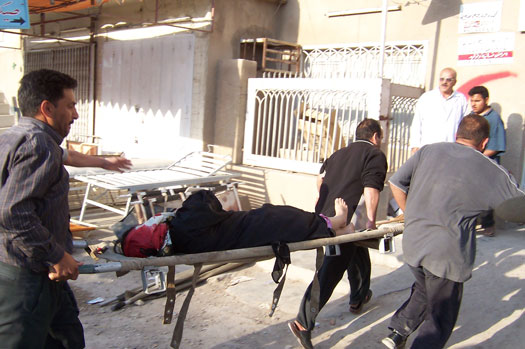
As I was there, an endless stream of women and children who'd been sniped by the Americans were being raced into the dirty clinic, the cars speeding over the curb out front as their wailing family members carried them in.
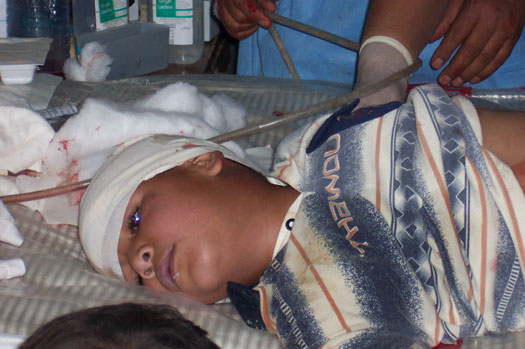
One woman and small child had been shot through the neck -- the woman was making breathy gurgling noises as the doctors frantically worked on her amongst her muffled moaning.
The small child, his eyes glazed and staring into space, continually vomited as the doctors raced to save his life.
After 30 minutes, it appeared as though neither of them would survive.
One victim of American aggression after another was brought into the clinic, nearly all of them women and children.
This scene continued, off and on, into the night as the sniping continued. As evening approached the nearby mosque loudspeaker announced that the mujehadeen had completely destroyed a U.S. convoy. Gunfire filled the streets, along with jubilant yelling. As the mosque began blaring prayers, the determination and confidence of the area was palpable.
One small boy of 11, his face covered by a kefir and toting around a Kalashnikov that was nearly as big as he was, patrolled areas around the clinic, making sure they were secure. He was confident and very eager for battle. I wondered how the U.S. soldiers would feel about fighting an 11 year-old child? For the next day, on the way out of Falluja, I saw several groups of children fighting as mujahedeen.
After we delivered the aid, three of my friends agreed to ride out on the one functioning ambulance for the clinic to retrieve the wounded. Although the ambulance already had three bullet holes from a U.S. sniper through the front windshield on the driver's side, having westerners on board was the only hope that soldiers would allow them to retrieve more wounded Iraqis. The previous driver was wounded when one of the sniper's shots grazed his head.
Bombs were heard sporadically exploding around the city, along with random gunfire.
It grew dark, so we ended up spending the night with one of the local men who had filmed the atrocities. He showed us footage of a dead baby who he claimed was torn from his mother's chest by Marines. Other horrendous footage of slain Iraqis was shown to us as well.
My entire time in Falluja there was the constant buzzing of military drones. As we walked through the empty streets towards the house where we would sleep, a plane flew over us and dropped several flares. We ran for a nearby wall to hunker down, afraid it was dropping cluster bombs. There had been reports of this, as two of the last victims that arrived at the clinic were reported by the locals to have been hit by cluster bombs -- they were horribly burned and their bodies shredded.
It was a long night-between being sick from drinking unfiltered water and the nagging concern of the full invasion beginning, I didn't sleep. Each time I would begin to slip into sleep, a jet would fly over and I wondered if the full scale bombing would commence. Meanwhile, the drones continued to buzz throughout Falluja.
The next morning we walked back to the clinic, and the mujahedeen in the area were extremely edgy, expecting the invasion anytime. They were taking up positions to fight. One of my friends who'd done another ambulance run to collect two bodies said that a Marine she encountered had told them to leave, because the military was about to use air support to begin 'clearing the city.' One of the bodies they brought to the clinic was that of an old man who was shot by a sniper outside of his home, while his wife and children sat wailing inside.
The family couldn't reach his body, for fear of being sniped by the Americans themselves. His stiff body was carried into the clinic with flies swarming above it.
The already insane situation continued to degrade, and by the time the wounded from the clinic were loaded onto our bus and we prepared to leave, everyone felt the invasion was looming near. American bombs continued to fall not far from us, and sporadic gunfire continued. Jets were circling the outskirts of the city.
We drove out, past loads of mujahedeen at their posts along the streets. In a long line of vehicles loaded with families, we slowly crept out of the embattled city, passing several military vehicles on the outskirts town. When we took a wrong turn at one point and tried to go down a road controlled by a different group of mujeheen, we were promptly surrounded by men cocking their weapons and aiming them at us. The doctors and patients on board explained to them we were coming from Falluja and on a humanitarian aid mission, so they let us go.
The trip back to Baghdad was slow, but relatively uneventful. We passed several more smoking shells of vehicles destroyed by the freedom fighters; more fuel tankers, more military vehicles destroyed.
What I can report from Falluja is that there is no ceasefire, and apparently there never was. Iraqi women and children are being shot by American snipers. Over 600 Iraqis have now been killed by American aggression, and the residents have turned two football fields into graveyards. Ambulances are being shot by the Americans. And now they are preparing to launch a full-scale invasion of the city.
All of which is occurring under the guise of catching the people who killed the four Blackwater Security personnel and hung two of their bodies from a bridge.
Dahr back from Fallujah
Dahr hasn't posted in a few days because he's been traveling. We are just posting quickly to let all of his readers know that we heard from Dahr today, Sunday April 11. He just returned to Baghdad from a trip to Fallujah. He will be posting about what he saw there soon. Thank you all for your continued support of Dahr's work.
April 09, 2004
Continuing Slaughter, Kidnappings, US Rhetoric
The horrendous situation in Iraq continues to degrade. I write this holed up in an apartment in the Karrada district of Baghdad with my friends, all of us afraid to venture too far from our abode, and rightly so. We have three armed guards on the roof, as well as on the first floor of our small apartment building, and all of the lights on the outside are turned on.
We’ve heard reports of a British contractor in Nasariya who has been missing since Monday, 6 GMCs torched en route from Jordan, the passengers shot (unconfirmed), 3 Japanese civilians were kidnapped in the south and are being held with the demand that if the Japanese military doesn’t pull out of Iraq in 3 days, the civilians will be burned alive.
The videos of the blindfolded Japanese with men holding RPGs and Kalashnikovs behind them are rather disconcerting.
There’s more; seven Korean Christian workers were kidnapped en route from Amman to Baghdad (then later released), two Arabs who live in Jerusalem have been kidnapped here, the U.S. military aggression against Falluja continues -- the city remains powerless and without electricity, a mosque was bombed with 40 people killed (graphic images of dead women and children are being shown on Arab television), and in the last week 459 Iraqis have been killed by the Americans (280 in Falluja alone), along with at least 35 U.S. soldiers. In addition, several trucks delivering aid supplies to the besieged residents of Falluja were shot by the U.S. military. The U.S. military are also dropping cluster bombs on Falluja -- yet another war crime.

U.S. troops keep a watchful eye out for insurgents.
A close Iraqi friend angrily said to me tonight, “They kill 280 Iraqis in Falluja because four American mercenaries were killed? This is the justice? This is fair?”
In recent weeks, there was not much bloodshed in the north. However, U.S. troops shot 8 pro-Sadr demonstrators in the northern city of Kirkuk, inflaming the already angry population there. The U.S. military also opened fire on a busload of Iranian pilgrims traveling between Najaf and Kerbala, killing 4 and wounding several others.
Any illusion of the U.S. having any control of the situation is just that. Any media that reports otherwise is simply not reporting the truth.
Everyone here is frightened, fearing for the worst, and just waiting. This is by far the most tense it has ever felt in Baghdad, even compared to when I was here in December and January when there were several large bombings as well as Saddam’s capture triggering widespread fighting against the occupation forces.
Meanwhile, we have live broadcasts of Condi Rice repeating her lies to the 9/11 Commission, General Sanchez is speaking of how things are under control in Iraq, and George Bush is at his ranch in Crawford, Texas.
Sadr’s militia have taken full control of the holy city of Najaf and of Kut, and the U.S. military, at least for now, will not enter Najaf to arrest him for fear of worsening the situation. This must be one of the few times I’ve ever seen them make a semi-wise decision, in the shadow of triggering this whole debacle to begin with by announcing Sadr will be arrested, after they’d closed his newspaper.
So here we are on the one year anniversary of the fall of Baghdad, and the U.S.-led coalition has lost control of two cities in Iraq to Muqtada Al-Sadr’s militia. This reminds me more and more of Afghanistan, where anywhere outside of Kabul is extremely dangerous, with the majority of the country controlled by warlords.
The military attacked Sadr’s office in Thaora, where I had recently interviewed a spokesman for Sadr. Today the images of the small compound with huge shell holes blasted in the walls and bullet pockmarks flashed across Arab television stations here.
What has this accomplished for the U.S. in Iraq? They are uniting the Shi’ite and Sunni populations against them. Sunni and Shia are fighting side by side in many places against the Americans. They are holding food, blood, and money drives to support their besieged countrymen and women in Falluja, Ramadi, Nasyria, Kut, Thaora, Shu’ala, and elsewhere throughout Iraq.
Even the followers of Sistani are outraged at the violence they are witnessing, as more and more Shia are joining the burgeoning violent resistance against the occupiers of their country.
In what is perhaps an ominous foreboding of things to come for the U.S. in Iraq, a huge demonstration of Shia and Sunni people broke through a U.S. military checkpoint on the perimeter of Falluja, chanting vehemently, “Sunni, Shia, we are united against Americans and fight for our country together!”

A mosque in the embattled city of Falluja, about 500 meters from the mosque that was the site of fierce fighting and numerous civilian deaths.
April 08, 2004
TNS Article Posted: US Crackdown vs. Shi'ite Demonstrations
Eyewitnesses report unprovoked attacks by US forces against otherwise peaceful demonstrations in two predominantly Shi'ite Baghdad neighborhods, contradicting official US accounts. Read "Following Violent Crackdown on Protests, Anger Rules Shi'ite Streets" by Dahr Jamail, published by The NewStandard.
Public Citizen Releases its Call for Investigation of Bechtels Failure to Repair Iraqi Water Supply
An important document, to which Dahr Jamail contributed heavily with research on the ground in Southern Iraq as well as substantial authoriship, is now posted at the . There is a which nicely summarizes the report's findings; the , in the form of a letter to members of Congress, is a 16-page PDF document that details the extent of Dahr's and Public Citizens' research.
Blood Bags of Solidarity
Khadamiya is usually a bustling, crowded and busy area in Baghdad. Today, the day after fighting here left three soldiers and at least one Iraqi dead, the streets are eerily empty.
I'd come here to talk to folks to get the Iraqi side of the story about what happened during the fighting. Shortly after entering the area, I found myself sitting with Sheikh Hassam, the Imam for Sadr's mosque in Khadamiya. A gentle, soft spoken man in his 30's, the Sheikh was more than happy to entertain questions about the recent horrific events caused, primarily, by his leader's reaction to Bremer's order to close Sadr's newspaper.
He is the Friday prayer leader, and the carrier of Sadr's messages to his followers in Khadamiya. While most of the predominantly Shia population in Khadamiya follow Sistani, there is still a large following for Sadr here.
According to the Sheikh, yesterday one Iraqi here was killed, and the US military entered Sadr's office and took all of the pictures of Muqtada Al-Sadr. He claimed that the people who attacked the Americans when the military opened fire were not from Sadr's Mehdi militia, but were other resistance fighters from outside the area.
However, when asked how the followers of Sadr would respond if he were arrested by the Americans, he replied, "Our country will be full of blood if Al-Sadr is arrested." He also claimed that he and Sadr are simply following in Sadr's dead father's footsteps, and that the Mehdi militia was only formed to protect the mosques and Imams. He said that the fighting we are seeing now are not the Mehdi, but an Intifada (uprising) against the Americans. Funny thing, that so many reports and photos of the Mehdi militia marching in Sadr City and fighting against the military over the last days directly contradict.
Never underestimate the power of propaganda on either side in a war. He also claimed that there has never been a problem between the Shia and Sunni people before in Iraq until the Americans came. The souls in the mass graves of Saddam would beg to differ.
Stopping in a small jewelry store near the main mosque, Abu Du'a, a Shi'ite, is a staunch follower of Sistani. He feels that 3/4 of the Shia in Iraq disagree with Sadr and his fiery talk and militant opposition to the occupation. He said, "Many people die these days. Why? Everyone followed his father, but we cannot say that because his father was great, he is great."
Both Abu Du'a and his friend talking with us, Abu Zahar, agreed that this current violence is useless. They both will wait as long as Sistani asks them to, even if it means more years like the chaotic, bloody one which just passed.
Out the window a small but vocal group of Sadr followers marches down the street chanting support for their embattled leader.
Both men believed Sadr's followers were poor, uneducated thieves. The prejudice between the sects continues to rear its ugly head.
But Sistani's continued waiting... how long will it last? How many more Shia will die before an Intifada is called? How will Iraqis react when watching their countrymen slain en masse by the Americans on a daily basis?
Driving home past the Abu Hanifa mosque in Al-Aadamiyah, a mostly Sunni and very pro-resistance area of Baghdad, throngs of upset people are crowded about the mosque. Small trucks outside are being loaded with bags of food, boxes of bottled water, and death shrouds for the slain. The people of Aadamiyah, in solidarity with the people of Falluja currently under siege by the U.S. military, are gathering supplies to attempt to get it inside the city which is currently sealed off.

Omar Khalil, speaking with great conviction, tells me, "This is Islam! We give all of this aid on our own. We are calling for more trucks, because we already have 5 lories full of supplies."
Meanwhile the loudspeaker from the nearby mosque is giving instructions as people frantically load bags of potatoes, rice, flour, and other foodstuffs into the trucks. Each time a truck fills, another empty one pulls up and begins to be filled.
I begin walking into the mosque and a man named Khalil pulls me aside and passionately says, "This is the second Halabja! This is worse than what Saddam did in Halabja! Where is the freedom? Saddam did Halabja, but the Americans are doing a greater Halabja now!" (Halabja refers to the horrendous gassing of the Kurds by Saddam, estimated at 10,000 deaths.)
He then looks me in the eye and firmly says, "Why are 60 innocent people in Falluja killed because 4 Americans were killed there? If the American Army wants to stay in Iraq, you must kill all of the Iraqi people!"
After this rally, people are pushing their way to the blood bags, and men sit in small groups while doctors jab needles in their arms. Men sit furiously pumping their hands while their blood flows into the bags on the ground.
While I type this the blood of Al-Aadamiyah is trying to make its way into the veins of bleeding Iraqis in Falluja, Ramadi, and elsewhere where it flows throughout Iraq tonight.
April 05, 2004
Entering the Inferno
It began as a smooth entry into Iraq, crossing the border in record time as the four U.S. soldiers watched us just drive on by. But as my friend Rahul and I neared Ramadi and were chased by the Ali-Baba (thieves), we were jolted back into the chaos of an occupied Iraq on fire with rage against the Americans.
Let me begin by reporting that there were U.S. soldiers, surprisingly, at the border this time. They had no hardware visible, other than their M-16's. They stood idly by smoking cigarettes, watching some of the cars roll past. I wouldn't exactly say they were vigilant, in that neither myself nor Rahul, nor our driver was searched. Nor was the car. Nor were any of our bags. But, there were soldiers there, so I can report that this token gesture toward security is an improvement, useless as it may be in fulfilling its goal.
The drive went smoothly for a while, our Caprice gliding down the sunny highways through the occasional sandstorm at a cool 100 mph.
We had to take a detour off the highway to overtake a large U.S. convoy, and when trying to get back on the highway a car stopped in front of us, blocking our entry back onto the road. Another car with several men was approaching directly toward us from the back, apparently in an attempt to trap us. Our driver immediately put the car in reverse and pulled an admirable three-point turn to get us onto the highway via another nearby entry and we sped off.
He let out a deep sigh and said, "Ali-Baba" while pointing back towards the two cars on the side of the road from which we came.
Very shortly after this we came upon another Capris parked on the side of the highway just outside of Ramadi. Inside I saw three men. Our driver pointed at the car and said, "Ali-Baba, this car." Just as we passed it the car took off in pursuit of ours, as we were traveling alone. Needless to say, our driver immediately maxed out our engine, and we outran them after a few minutes of nervously checking out the back window. They had maintained a distance from us for a time, but then gave up when they realized they would be unable to catch us before we came upon another convoy just ahead. As we watched their car fade behind us, our driver angrily stated, "Ali-Baba no good!"
Just after catching our breath from this, we come upon a place where the U.S. military had sealed off the highway just outside of Falluja. The entire city was sealed off, as the military was preparing to 'pacify' the entire city with Operation Vigilant Resolve, the reprisal for the killing of four mercenaries the other day by resistance fighters. So when Iraqis are defending themselves against these hired guns, the military responds by sealing the entire city, and as I type, blood is most certainly flowing in the streets of Falluja.
We are forced to wind our way around back roads on the outskirts of Falluja, and are not happy about this. Our driver pulls over and shuts a towel in my door to cover the window, and stretches a windshield cover with an eagle on it across Rahul's window. "Nice eagle," I say smiling at him nervously, and he replied, "This is a good way of not looking American." My driver asked me to cover up with my Kefir, which I gladly did-making myself look like a Fedayin with eyeglasses. We nervously drove a long while before getting clear of Falluja, and into Baghdad.
Our brief respite was met with more terrible news from my friends in Baghdad and reading more of the horrible news. In Kufa, Sadr's militia took over the police station, an oil pipeline in the south has been torched, and across Iraq over the last two days no less than 60 people and 12 soldiers have been killed in fighting. These are merely the highlights.
So while a large portion of the Shia are now openly fighting against the occupiers, Operation Vigilant Resolve is being launched against the city of Falluja. Now all we need is for Bremer to drag the Kurds into this somehow, after he has already called Al-Sadr an 'outlaw.'
This is a far worse situation than anything I experienced my last 9 weeks here. Everyone is scared and on edge. Most hotels aren't accepting any foreigners at all. Iraq is on fire today, and right now the flames are only growing higher as the outrage toward the occupiers has drawn the militant Al-Sadr and his huge following into the battle against the Americans.
April 03, 2004
From Amman, on Fallujah
Amman, Jordan - By now I imagine everyone has been properly inundated with the images of the scorched bodies of the 'American Civilians' (as properly parroted by the corporate media) in Falluja. In case I missed it before departing, I had one last chance to catch it on the countless televisions in JFK airport, then on the front page of the NY Times on the plane.
I thought it was interesting, because what accompanied this story was a strange little phenomenon I've seen many times in Iraq. The first bit of news released on the attack referred to the men killed as 'contractors', and even showed an Iraqi man handling the dog tags of one of them, and another man was holding a Department of Defense badge from another of the U.S. fighters the Iraqis had killed. The same report mentioned that a collection of weapons was in one of the vehicles as well.
Of course that was the last of that footage I saw. From then on, it was 'Americans killed by Iraqis!', or 'Contractors Killed', over and over ad nauseum.
Well, it turns out these 'Americans killed by Iraqis' just working for a N.C. Security Firm called Blackwater Security Consulting.
This subcontractor, along with countless others, is working to provide 'security' in Iraq. Check out : because they even provide training for SWAT teams and former special operations personnel.
I've been in Falluja when the entire city has been under collective punishment, which occurs nearly everytime someone attacks a U.S. patrol there. People are enraged, and rightly so. So when one of those white, shiny SUV's with the big black antenna drives by with guys with crew cuts in them wearing body armor holding guns (yes, it is THAT obvious and easy to see), what do you think might happen to them?
The other reason I bring this up is because of this: Last night I'm going through customs at the airport in Amman, and I find myself standing in line behind five men with crewcuts and their 'handler', a little bit older fellow from Turkey (I saw his passport). The men were all in their late 20's, to late 30's I'd say, and from their discussion had all been in Iraq before.
They wouldn't tell me who they were working for, but when they were lugging huge plastic boxes with locks on them off the baggage belt, then went and hopped into their nice, white SUV, it was pretty much a no-brainer.
Blackwater Security Consulting won a $35.7 million contract to train over 10,000 soldiers from several states in the U.S. in the art of 'force protection,' according to Mother Jones magazine. They also hire mercenaries from South Africa and other countries as well, and the pay in Iraq is $1,000 per day. Wonder how that makes our soldiers feel, who make barely over that each month?
So the residents of Falluja are about to be 'pacified' because some of the resistance fighters there killed what were most likely mercenaries who regularly attack and detain residents of Falluja. The fog of war grows thicker in Iraq, as the privatization contracts continue to be signed.